Monday, October 19, 2015

Hunting or Shooting?

     One of the things I love most about Wyoming – in fact, the rural West – is our “live and let live” attitude. We recognize that we aren’t all alike, and that’s OK. Maybe it’s a product of low human density or maybe it’s about the fact that most of our families – shoot, ALL of our families unless your last name is Her Many Horses or Standing Elk – came from someplace else. There’s nothing like being a short timer in a new place to help you be pretty tolerant of other folks.       
     So I try never to get real judgmental when it comes to the way other folks hunt or fish. I’m mostly a fly angler, but I don’t care if you want to fish with gear. That’s your call, not mine. As long as you’re legal, I’ll fish with you any day. Like my buddy Dave says, “If you want to fish, bring your fly rod. If you want to catch fish, bring a Zebco and some nightcrawlers.” Same goes for hunting. If you want to shoot some prairie dogs, go for it. For me, it’s about as exciting as watching grass grow. But if you want to vaporize some rodents with your .223, I’m not going to get in your face about it. The last thing hunters or anglers need is to be fighting among themselves these days. There are plenty of folks who view us as an embarrassing anachronism and would love to see hunting and fishing go away entirely.
     And I guess that’s why I’m up on the 3EM soapbox today. I want to suggest that we need to think about something a bit. Here it is: long distance shooting. An outfitter friend tipped me to this trend at least a decade ago and it’s grown like a cancer since then. He said that he was getting clients every year who weren’t really interested in hunting, per se. They just wanted him to get him within 1,000 yards or so of a game animal so they could set up like a military sniper and kill that animal from some amazing distance. These Chris Kyle wannabes have even spawned an entire niche of expensive weaponry to do their thing: 6.5 x 284, .30/.378, .338 Lapua - heck I’m sure there’s somebody out there looking down the barrel of a .50 BMG at some unsuspecting antelope as I write this. Just Google “long distance shooting” and see what you get.
     But let’s be real clear about what this is: It is shooting. It is dang cool to be able to hit a milk jug at 1,500 yards. Never having been much more than an adequate shooter on the best day I ever had, I’m impressed with someone who’s willing to learn to hit a target almost a mile away. The evolution of both rifles and optics has enabled regular people to achieve amazing accuracy at amazing distances, given a willingness to shell out a lot of cash for the appropriate technology and a lot of practice.
      But let’s be equally clear about what it is not: It is not hunting. Hunting is much different than shooting. Hunting is about a deep knowledge of and a deeper reverence for wildlife. It’s about understanding the history of hunting in America and the conservation miracle that hunters and anglers brought forth in the last century. It’s about knowing where these critters live and how they live and sharing a bond with them and with the wild country they live in. It’s about having an attitude of gratitude for the opportunity to be there and a willingness to work very hard to get close enough to make one, clean humane shot. It’s about feeding the people you love with the meat when it’s all over. All told, being a hunter isn’t something you buy, it’s something you earn.
     So if you’re into target shooting at ultra-long ranges, God bless you. By all means, shoot a lot. Buy some real expensive guns and reload a lot – the excise taxes on all those guns and reloading components fund a lot of cool conservation work. Get good at it. I want you on my team if there’s ever a zombie apocalypse. But if you’re out there shooting at an elk at 1,100 yards, shame on you. You’re not a sniper – you’re a lazy slob, and you’re certainly not a hunter. Don’t post your kills on social media – I don’t want the rest of society to confuse you with someone I care about. Those are not targets, they’re wild, free-ranging animals and they deserve more respect than you’re ever going to be capable of giving them.

-Grandpa

Sunday, October 11, 2015

Antelope Hunt 2015

     My dad had just shot his antelope (a nice two year-old buck) and we were in the process of quick quartering and boning out the quarters on the back of the pickup. The game warden came and checked per usual, and everything checked out - we were good. So we went off in search of many more antelope for the freezer. Not far along, we saw a group of about ten antelope on the side of a hill. So Grandpa, the Ranger, and I went down a goat path of a two track, around and up the back of the hill. When we got to the top, they were gone.
     So then we split up - ApprenticeDad, Grandpa, and I in one truck and Mark, Grandma, the Ranger and the dog in the other truck, going the opposite direction. So we looked and looked, occasionally seeing a jumpy buck 500 yards from anything that remotely resembled a piece of cover. Then finally on the way to lunch, we saw a group of about seven and according to Grandpa, they were about 200-250 yards away (I don’t quite believe him). So I plopped the tailgate down and took a crack at the last one in the bunch (a yearling buck) with my trusty .243. There is a very distinctive sound when your bullet makes contact with a body, kind of a thwack. We heard a thwack but he didn’t go down. So Dad and I headed after him. When we saw him, I put the scope on him, took a shot and he dropped deader'n a stone. And I was so happy.


-The Apprentice

The Ranger:
       
    Inhale, exhale, the cross hairs find their mark, but still moving too much. Her ears twitch; she notices something. Inhale, exhale. The cross hairs are steady now. Inhale, exhale. Finger tightens on the trigger. Inhale, exhale. The trigger is pulled back far enough and at once the firing pin drops. 6 grams of gunpowder are suddenly ignited. Their gases build up and build up inside the cartridge until they can stay in no more. They have to get out. They have so much pressure that a little pointy piece of lead, covered in bronze, suddenly is pushed out of its case and starts heading out the barrel. Through its way out, spiraling grooves along the barrel give it a spin. It exits the barrel and moves at 3,200 feet per second, around Mach 3, the maximum speed of an SR-71 Blackbird. As it penetrates her skin, it has so much velocity and inertia that little can stop it. It turns everything it hits into jelly. She goes down like a ton of bricks. Another successful antelope hunt for the Ranger, 2015.       

-The Ranger

Friday, September 25, 2015

The Northern Mystery

      The Spanish called it the “Northern Mystery” - the unspeakably vast country north of the Sangre de Cristos, beyond the missions and the trails. They tried it, but soon turned back. It was too big, too empty, and too cold. The natives were fierce and the treasure too elusive. Father Escalante came up the Rio Verde – the Green River - as far as Marsh Creek in 1776. The old timers say that when Ashley and his men came down the river there were adobe buildings – clearly Spanish in design - near Brown’s Hole on the river. The Utes were vague when asked about it, but they were willing to say that some men came up the river from the south and spent one winter there. When asked what happened to them, they would say only that they died and no more. A mystery within the Mystery…    
      Maybe it’s the mystery that draws me to and connects me with the sagebrush country of the interior West. Maybe it’s the history. There have been Gassons abiding in the sagebrush sea for four generations, a long time for non-native people in a hard land. Our history is a blink of an eye compared to the Shoshone and Ute people who came before us, but it’s long enough to put down deep roots. Deep roots are needed to survive here. But for those four generations, we have been nourished and nurtured by the waters of the Green. The thin ribbon of emerald green that starts on the west flank of the Wind Rivers and winds through the willows and cottonwood bottoms and canyons to meet the Colorado far below us has been our lifeline.
       But no one, no family can have a life by clinging to a lifeline. Most of our lives have played out, for better or worse, in the great wide open of southwestern Wyoming. For me, my father before me and his father before that we have been men of the sagebrush country. By foot, a-horseback and by pickup truck we learned to navigate the immensity of this country. Hot in the summer, cold in the winter and incessantly windy year-round, it is often unforgiving. But it is stunningly beautiful in every season and it touches my heart like no place on earth. 

    It’s antelope season in our country, and we’ll soon be out on some nameless two-track road, a little used shipping lane out on the sagebrush sea. We’ll be glassing and stalking and if we’re lucky we might even be killing an antelope or two. But mostly what we’ll be doing is teaching the next generation the importance of public land from horizon to horizon and their responsibility in caring for it. We’ll talk about the country, the people and the critters. We’ll watch the sun sink below the Wyoming Range and we’ll thank God that we had one more day of our history, one more chapter in the mystery of our country – the sagebrush country.

-Grandpa

Sunday, September 20, 2015

Camp Wapiti

       Every summer, our whole family gets together to do something pretty cool. We fired this thing up last year, it was a huge hit, and we want to keep it going. We call it Camp Wapiti. The grandkids of the fam get together, with our very own Grandpa and Grandma at the helm, and spend a few days in the outdoors doing all sorts of things like fishing, shooting, and hiking. How cool is that, right? So, a few weeks ago, we did it again. We rented a little cabin up by Laramie Peak, and the whole family gathered up there.
       The first day, after a breakfast of breakfast burritos, we hit the water on a little pond about a quarter mile away. The fishing was okay. We caught mainly eight inch rainbows with our biggest one being about ten. After that, it was time for me to give a little class to the young’uns about knot-tying! After that, they were all quite the square knot-masters. Lunch was next and then it was time to go

shooting! Everyone brought weaponry in one form or another, and we all got to shoot a .22. For two of the youngest, it was their first time ever shooting, so that was a pretty cool day. Grandma also had a go with my .22, and I’ll tell you what, she is so accurate that it is actually terrifying to watch her shoot. She robin-hooded it twice through the bulls-eye without skipping a beat. Those two antelope she’ll shoot this week won’t stand even the tiniest of chance. We decided never to make her mad with a gun, and moved on. The Apprentice gave a cool class about edible plants, then we headed back. A slight cool rain was starting, and The Apprentice and I thought it was a great time to hit the pond with fly-rods and dry flies. A cold, wet hour later, we were only semi-successful, a rainbow each, what would become breakfast the next day. That night we played charades and had s’mores. It was a great day at Camp Wapiti, we decided.    
Trouble in the making
     The next day, we went on a “Critter Cruze,” waking up at 0500 to

drive around and look for elk, deer and antelope. We saw a few mule deer, a few antelope, and a possible elk all within a few miles of each other. The picture on the left here shows why it is not a good idea to lend the wheel to me and Apprentice. We have lovingly titled it, “Trouble in the Making.” After more Cruzing around, we came upon something spectacular. After coming to the top of a little hill, we saw this amazing sight of the Laramie Mountains, displayed below. It truly is a beautiful land we live in.
      Camp Wapiti has showed me that we are free-range kids. Grandma and grandpa think so too, evidently. We have a blast every year, and it is a great bonding experience. It’s important that we teach the young guys to love the land, the critters in it, and He who made it.


-The Ranger


Tuesday, September 15, 2015

A Day on the River

       Last week Grandpa came up and we went on a long awaited fishing trip on a drift boat. We went with Grandpa’s friend Spencer, the owner of said boat. I learned that fishing on a boat is a lot different than bank fishing. I also learned that our river is an awesome place to hang out on!
       Grandpa came up and immediately we went out. We stopped at the local gourmet gastropub for fishermen (AKA the Loaf ‘n Jug) just long enough to get sandwiches and Cokes, and then went out to meet up with Spencer. After loading up, we went to one of the many launch spots along the river.
       After getting underway, I learned that there are a heck of a lot of differences between bank and boat fly fishing. Almost immediately I got a huge fish (ok, just 16-17 inches…I know a lot of you guys usually catch this size of fish but hey, I’m used to 9-inch brookies). Overestimating its size, I gave my rod my hardest tug to set the hook. In my haste, I broke the fly right off the leader.
       Over the next several hours, Grandpa landed three or four fish. While I had that many on the line, I would always tug not enough, or just a little too much to set the hook. About noon, we stopped and ate lunch. Then back on the water we went, to continue fishing. We kept on getting fish on the line and I kept missing them. We figured out the reason why we keep fly fishing, at this point. You keep on thinking, “I’ll stop as soon as I make a better cast,” but every time it’s not quite what you wanted, so you keep on a’castin’. Honestly, though, I was having the time of my life. Just feeling the tug that the fish gives sends an adrenaline rush from my hat to my boots.
       I loved fishing on the drift boat. Thanks, Spencer, for providing the means and the company to have an incredible day. Thanks, Grandpa, for coming up and fishing with me. And thanks, river, for the awesome time!

-The Apprentice

Friday, August 21, 2015

Countdown - Going Home

      It’s over now. The world’s best family vet has come and gone. So has Missy’s last day with us. She and Grandma and I shared a shady spot in the back yard. We sat and talked with her and petted her as Gary shaved a little spot on her foreleg. Then he gave her a quick injection in that leg and in a few seconds she was gone. No fear, no pain, not even a little surprise. She just quietly died. He left, and we just stayed there with her for a while. I don’t think we knew anything else to do. We cried for a while together.
      Then we picked her up, so thin and bony, wasted by her illness. We carried her to the grave we had prepared for her out in the east pasture. It’s getting to be a little crowded back there, with Molly and Dinah and Cat and now Missy. Maybe that’s one way to grade the meaning in your life – the number of animals who loved you unconditionally and who you grieved over and buried in your pasture. We gently arranged her body on her bed – in the same position she used when she slept on it. We said a prayer.
       Then very slowly, very gently we covered her with the soil of home. We replaced the buffalo grass and blue grama and flax in a low mound that will slowly even out over the fall and winter. By next summer, it will be shortgrass prairie again and her body will return to the land she loved.
     
     But her memory will live on. Her long, loping stride when she was in her prime. Her gentle dark brown eyes. Her love for a good ear rub. Her embarrassment at public displays of affection from cats. She was a kind, sweet, gentle soul who came into our lives and loved us unconditionally. She never judged us, always trusted us. She waited every day for just a little bit of our time – a run, a few throws of the tennis ball, her breakfast or dinner. She was meek and kind and humble. She was what we all wish we could be. She loved as we all wish we could love.
      And her spirit will live on. If you were to ask, “Do you think you’ll see her again?” I’d probably answer flippantly that no one as ornery and prideful and mean-spirited as I am should ever be allowed to sully the afterlife of a great dog like that. But what I’d really be thinking is that God would never have given us a dog like that if He thought that we’d only have a few years with her. What I know in my heart is that she’ll be there when we get there, and she’ll be strong and fast and full of life and happy to see us again.
      Most of the important things in life aren’t easy. Birth, death, love – all are hard, terribly hard sometimes. The very foundations of our lives are built of hard things, as they should be. Foundations, if they are to be foundations, must be hard to be strong. You blessed our lives in so many ways, old dog. God be with you ‘til we meet again. We love you.


-Grandpa

Tuesday, August 18, 2015

Countdown - Part 2

        Tuesday 9:00 AM – She’s happy today. She was up early and ready to be fed. She’s insistent about meals these days, not because she’s hungry but because she’s figured out that the pain pills come with the dog food. She keeps trying to move meal time up earlier and earlier. It’s not about the food, it’s about the pain.
       So we go outside and she totters around the north pasture a bit to take care of her business. She doesn’t like to walk outside much anymore because the footing is uneven and she stumbles and sometimes falls. She’s thin as a snake, weak and teetery. If she was bipedal, she’d be using a walker. But we go very slowly and she manages. She likes the concrete driveway – there’s nothing to trip over. I brush her and a cloud of hair goes sailing off into the breeze. She’s blowing her dry, brittle coat like crazy.
    
      We come inside and I feed her – canned dog food now because her teeth are just about gone and she has a tumor about half the size of a tennis ball under her tongue. Her tongue lolls out to the side because it has nowhere else to go. It breaks my heart to watch her eat, but I hide the Tramadol inside a chunk of dog food and she gets it down. Within minutes she’s resting quietly. She’s an addict, the canine Judy Garland.      
     She watches from the office window as Grandma and Jora go for a run. Three years ago, she was there. Chasing a cottontail, following a fox track. Not now. She watches them disappear in the distance. Another heartbreak. So we sit together and talk about the old days when she felt good. She doesn’t feel good any more, except when she can sleep.
        Last night, Grandma laid down beside her on her bed and just snuggled her. She’s always trusted Grandma. She relaxed and fell asleep. I hope that’s the way it goes when the vet comes tomorrow afternoon. I had hoped she would pass that way on her own, maybe even go when we were at the cabin. But that’s not going to happen. She clings to life like she’s afraid to move on. Maybe we all do, to one degree or another, when the time comes.

-Grandpa

Monday, August 17, 2015

Countdown - Part 1

     If you’ve followed this blog for a while, you know that most of our posts are pretty upbeat in tone. We take a great deal of joy in being a family who loves wild things, wild places, and each other. Once in a while, though, a little sadness creeps in. That’s OK. Life is not, as Long Rifle’s daughter reminded me recently, “pink fluffy unicorns dancing on gumdrops” all the time. We’re losing a member of the crew right now, and it hurts - bad. Missy, the almost-15-year-old Labrador is dying.      

     Monday, 3:30 PM - She came to us in 2008, already a middle-aged dog. She was a project, a rescue dog from our friends at the W9. She was in pretty bad shape, and she’d been through a rough time. She was thin and ragged looking, with a dull brownish coat. She was afraid of pretty much everything, especially men. We weren’t real sure we had room in our life for a dog anymore, but we couldn’t say no. She came aboard a few days short of her 8th birthday.     
     She was Grandma’s dog from the start. They learned to go for a run together every morning. It wasn’t easy. Missy didn’t understand what was expected of her at first. We even had to call in
an expert to teach us to redirect her attention so she didn’t go
berserk every time she saw another dog or a person or a rabbit. But in time, she came around. As the weeks went by, she learned quickly. And she morphed into an amazing dog. The dull brown coat all blew out and she was as shiny and black as a piece of obsidian. And just about as hard – she had muscles on top of muscles everywhere, as she settled in to a high quality diet and daily exercise. At 75 pounds and 0 percent body fat, she could lope forever. And sometimes she did.
       It was easy to see from the beginning that she would never hunt. Her bloodline was great, but too much troubled water had passed under the bridge and she was terrified of any loud, sudden noise. Gunfire, fireworks, thunderstorms were her demons. So we put away the notion that we had a hunter and loved her for who she was – sweet, strong and happy. She fit in at our outfit like she’d been born here. That winter, when Grandma’s running moved indoors to the treadmill, Missy and I moved outdoors to the school section west of our place. She’d retrieve a tennis ball no matter how far I threw it, no matter how many times I threw it, no matter how deep it was buried in the snow. Lots of times, it was pitch dark when we’d go out in the morning and she’d disappear into the void in her perfect nighttime camo, then reappear spectral a few seconds later with the snowy tennis ball clutched in her mouth. We became buddies that winter. We’ll always be buddies.

-Grandpa

Saturday, August 8, 2015

Never Fails

    Our family treasures our time in the outdoors. In the words of Frank Lloyd Wright, we “study nature, love nature, [we] stay close to nature. It never fails us.” In fact, my wife has spent most of her July at the cabin. Her father is convinced she may be going feral. She’s been up there with kids and she’s been up there with friends. She is taking advantage of nature’s gymnasium. She comes home rejuvenated and renewed after communing with God while watching the setting sun from a bench she discovered, tucked away up the road from the Cabin. And while she enjoys reading in the hammock, I find myself building an internal compass of the terrain.      
     After travelling with Grandpa, I discovered he knows every landmark in the great state of Wyoming and usually has a story associated with it. He gets great pleasure testing his progeny on both landmarks and stories. I’m still learning. This man has the best internal compass I’ve seen. He has crossed every inch of Wyoming territory, so when I brought up the idea of a Garmin Oregon 650 T GPS unit, I got the ever-so- clear Grandpa “eyebrow raise”. It is accompanied by the “what kind of bologna are you trying to feed me” look. However, he always follows up with the” I’ll hear ya out” smile and gives you a chance to explain your madness.
       The GPS has come in my rescue in a dicey situation or two. A couple years back, it was getting dark and I attempted to take a shortcut to the cabin. My internal compass was a little turned around and I found myself in unfamiliar territory. I pulled out the GPS and realized I wasn’t terribly far off, but off nonetheless. I followed the directions on my trusty Garmin and got back on track. Thinking my adventure was over; I turned off the electronic compass and went back to the internal. I found a solid trail and headed toward the cabin. Unfortunately, it was darker than an inside of a moose and I was off track yet again. I was getting to the point where I thought I may need to hunker down and build a fire, so I sat down and pulled out Garmin, just to see how far off I was. At first I thought it was lying to me as it showed me only about 300 yards away from the cabin. In a dark, heavily wooded area, 300 yards can seem like 300 miles. I headed east and heard a magical sound. My beautiful daughter was calling for her brother outside on the porch and I realized everything was going to be ok. Thank you, Garmin, for Bailout #1. Maybe a year later, I was trying to find my way to my opening morning hunting spot at 4:30 am in the pitch black. Moonlight and flashlight were not cutting it – the landmarks I was searching for were hidden in the darkness and I needed to be on the trail. I pulled out the GPS and it took me right to the sweet spot. Thank you, Garmin, for Bailout #2.        
      Technologic advances have their place and time and a GPS can be a helpful tool. Grandpa is slowly warming up to the idea, but I agree with his warning, “Make sure you know the land, my son.” I am grateful Grandpa sent me on walkabout more than a few times to learn the land. His patient teaching and guidance is the only true way to learn the landmarks I need to be familiar with. I need to know the subtle hills and clumps of trees, the old fences and rushing creeks. I want to know where Ole Luke and Grandpa Gus killed that cow elk or that bull moose. This, my friends, is institutional knowledge. I gotta tell ya, though; nature may never fail me, but every once in awhile my internal compass does. And that’s when Garmin sure comes in handy.


-Long Rifle

Wednesday, August 5, 2015

Thank you, Waite Phillips!

      Our family loves Boy Scouts. The program teaches the values that we strive live every day: honesty, hard work, love of the outdoors, loyalty, and duty to God and country. Every one of the boys in our family that’s old enough is a Boy or Cub Scout, and a fair few number of the parents are involved in Scouting. Last week, Apprentice-dad and I went down to New Mexico to experience the Philmont Scout Ranch.
        First off, a wee bit of history. At the age of 16, Waite Phillips (pronounced White) and his twin brother Wiate set out in 1899 from their small family farm in Iowa to explore the still-Wild West. Wiate Phillips unfortunately died in July of 1902 near Spokane, Washington. When Waite returned home, his two older brothers (who eventually went on and started Phillips Petroleum Company) sent Waite to college and gave him a job in their rapidly growing company. After selling his shares for the equivalent of over $50 million, he started his own extremely successful business and continued his love for the West.

      He bought the 300,000-acre UU ranch near Taos, New Mexico in 1922. Ultimately, he donated this property to the Boy Scouts of America on the condition that the ranch would make Scouting a family activity.
       So back to the present: my dad and I went down there last week so that my dad could have some training and I could have some fun. We left early one morning and made the drive to New Mexico. We listened to Harry Potter on CD all the way down, so it made for a pretty quick 9 hours in the car. When we got there, we got settled in our tent and explored the incredible Philmont property.
       Over the next couple of days I went rifle shooting, did archery, stamped belts, did some blacksmithing, and went horseback riding. My favorite activity was the horseback riding. My horse, Trigger, had anger management issues. Funnily enough, we got on mighty fine (Is that reflective of my personality?). But bottom line, it was great to be on a horse again. It had been awhile!

        On the third day, Dad and I went on a hike and then went into Taos. For those who’ve never been to Taos, imagine Jackson Hole built out of adobe bricks, with lots of Mexican restaurants and art galleries. I got my first real cowboy belt buckle there and then we went to eat. We went to this Mexican grill and it was amazing. We got stuffed jalapenos and green chili chimichangas and oh my, they were good. I also answered New Mexico’s state question: red or green? The answer, of course, is green.
      The next day, I went on an overnighter in some truly beautiful country. We hiked through fields of 6 ft. tall sunflowers, oak forests, and prairie than looks a lot like home. When we stopped for lunch, we each got a sealed bag filled with all sorts of snack food. And in that bag was the famous “Spam.” It was the first time I had the opportunity to try Spam, and I am proud to say I made about half way through the “block.”
       The rest of the overnighter was relatively uneventful. We played football in pouring rain, and swatted flies in return for homemade root beer in a cantina. The next morning, we woke up and hiked the mountain at a tremendous pace, only to stop at an outpost to play some baseball.
       After getting back, we went on a low ropes course. We then planned a skit for the night’s closing campfire. Our skit was a mix between the classics, a fire drill, and the girl scouts. It was a big hit among those who saw it.
       All in all, I had an awesome time in God’s country. We laughed and learned, we hiked and played. Thank you Philmont, and thank you, Waite Phillips!

-The Apprentice

Saturday, July 25, 2015

Grandpa on the Trail - Part 2

       When we last heard from our aged correspondent, he had successfully negotiated his way down the long and dusty trail and through the ignominious squeeze chute. He had purchased staples for his journey (including the ever-present Coke Zero that fuels all things Grandpa) and moved on to the loading corral. He’s about to be loaded for shipment…
Photo courtesy of Emirates Airlines
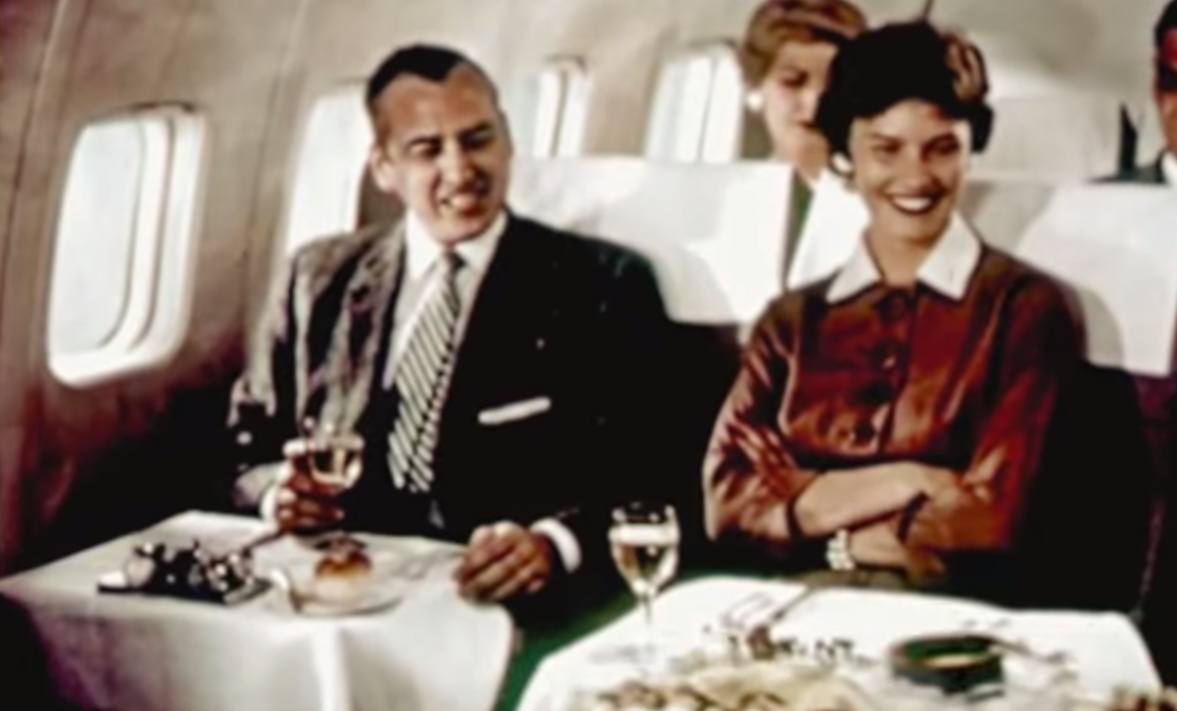
    From the loading corral, we’re hustled (again amid the customary noises and smells of moving livestock in confined spaces) into the “bull-hauler”. Long, long ago the bull-hauler experience was much different. You dressed up for it. They fed and watered you well. They smiled at you. Now, not so much. Now they just run you down a long alley onto the bull-hauler with as many other critters as they can squeeze in there and shut the gate behind you. There used to be signs welcoming you. Now they should have signs like the ones that once graced the Coliseum – “abandon hope, all ye who enter here”. I have dozens of quaint and charming experiences traveling by bull-hauler. Like the sultry summer day when we paused briefly on the tarmac in Newark for two hours to allow some thunderstorms to pass, and shut off the engines to conserve fuel that might have been wasted in keeping the air conditioning on. The Angus bull next to me was soon bathed in perspiration, which he generously shared with me. Or the wonderful in-flight
Photo courtesy of The Ranger
entertainment provided by the vaca loca en route from Atlanta not long ago. She had self medicated with a mix of drugs and alcohol at the loading corral to ease her anxiety (a habit I may well adopt myself) and proceeded to bawl and puke her way up and down the center aisle of the bull-hauler as we flew the friendly skies across the American heartland.
        But the charm of the bull-hauler is all too soon behind us as we once again are herded through the long alley and out to our new home on the range. Sometimes it’s a familiar pasture where we know all the best places to feed, water and rest while we chew our cuds. Sometimes it’s to new and dangerous pastures where I go with a briefcase to places I probably should go with a shotgun. Usually, there’s way too many critters already on what little grass is out there. I mill around for a couple of days and sometimes get rimrocked in the concrete canyons of Washington, DC or bogged down in the creek crossings of Providence, RI. But never quite soon enough, I'm back on the bull- hauler and headed for the home place.
      And I guarantee you my friends, despite all the joy of travel, Judy Garland said it best. There is indeed no place like home.


-Grandpa

Thursday, July 23, 2015

Grandpa on the Trail - Part 1

      For a guy who set out to experience life never more than 150 miles from Green River, WY I seem to have managed to become a pretty seasoned traveler. It wasn't something I set out to do. It just sort of happened. Like an earthquake or a head-on collision with a logging truck, it was just one of life’s happy little surprises. So, given my status as an accomplished road warrior, I approached my colleagues here at Three Elk Meadow about becoming the designated travel correspondent.
        I pitched them the opportunity to bless you readers with the glamour of exotic places, the excitement of adventure, the thrill of discovery. Quite honestly, they seemed a little slow to catch the vision. So, in the tradition of great travel writers, I've decided to bravely forge on. I can only assume that Rudyard Kipling and Alexis de Toqueville encountered nay-sayers in their time, but did they simply quit and go home? They did not, and neither shall I, dear readers, neither shall I.       

      My work gives me the opportunity to travel a lot. It’s very glamorous. One of the best parts is what I fondly refer to as “shipping time”. For bovine or ovine passengers, it usually happens only a couple of times in a lifetime. For me, it happens once a month. Usually, it starts at some unearthly hour of the morning, when (like the ovids and bovids) I'm awakened out of a peaceful sleep out here on the range and herded onto the trail. Regardless of what you may recall from watching Rawhide when you were a kid, life on the trail is not a leisurely stroll from San Antonio to
Abilene. Usually, I join the herd moving from Cheyenne to Denver before the sun is up, but they're already on a hard lope. The speed limit on this trail is 75, but the only time we see that is when we’re speeding up or slowing down – and we do that a lot. Various scenic wonders along the trail (like a Subaru pulled off on the shoulder or one-dimensional skunk on the center line) cause the herd to balk, mill aimlessly and eventually come to a complete halt for a while. But eventually we get it sorted out and are happily back at 90, making our way to the next stop in our ordeal, uh.. I mean adventure.      
With only a minimum of bawling, mooing and bleating we make our way to the “squeeze chute”. This is a relatively new part of the whole shipping experience, designed to remind us that we are indeed livestock, and that we will be handled as such. After checking our brands to make sure none of us are mavericks, and touching us in places that would in any other circumstances land them in jail, the brand inspectors herd us into the “loading corral”. I've found this is a good time to feed and water if I can. The options are few and expensive, but it may be the last chance for a while so I'm usually happy to pay 20 dollars for a Coke Zero and a bag of Fritos. Experience has taught me that this may be the culinary high point of the next 12 hours.

-Grandpa

Monday, July 20, 2015

Happy Birthday, Wyoming!

Happy Birthday to you,
Happy Birthday dear Wyoming,
Happy Birthday to you!

Are ya one, are ya two, are ya three, are ya four…


     So a few weeks ago, this awesome state turned 125 years old. In my last post, I rambled on about being a Wyomingite, so this time I’d like to get a little bit into the history of the place. In my quest for knowledge over the past week, I’ve learned a ton about our state, and I’d like to share a little bit with you now:
Wyoming officially became a state on July 10, 1890 as the 44th state in the Union. But there’s so much more history to it before. In fact, there’s many thousands of years of history before that, but I’d make you spend the rest of your day sitting there and reading it, so I’d rather not. Wyoming was defined by three totally different things: equality, the railroad, and mining. Let’s get started!

      First, equality. We were the first state to give women the vote! This was even before we became a state, in 1869, while we were still the Wyoming Territory. William Bright sponsored a bill to allow women to vote. Wyoming thought, “why not?” and passed it into law. The suffragist Susan B. Anthony traveled here by way of the newly completed Transcontinental Railroad to “the land of Freedom” in 1871, which I bet was pretty cool. The 19th Amendment gave the rest of the nation’s women the vote much later, in 1919.
Next, the railroad: a biggie. The Transcontinental Railroad, completed in 1869, was groundbreaking. It brought together the East and the West. New York to Sacramento, what used to be a grueling, perilous journey of six months by wagon, took now only a mere two weeks. Although, as Grandpa will talk about in his upcoming post, the grueling perilous journey of six months is still the same today with modern air travel. Many cities in Wyoming were founded because of it, including Green River, Rawlins, Laramie, and Cheyenne.

     Lastly, coal! We produce 40 percent of the nation’s supply of it. Long ago, although it seems weird, Wyoming was mostly underwater, and the bits that weren’t were tropical paradise. When all that stuff decomposed over millions of years, we gained tons of resources including coal and oil. Wyoming mining has transformed both us and the rest of the nation. You can’t swing a dead cat here and not hit some mine or other, usually coal. Grandpa spent some time down in the mines living in Green River way back when. Poor thing.

     So there we are. A few things that have transformed Wyoming from the wild west, vast and untamed, into the state it is today. I’m proud of all the work these people have put into it, and the great product it is today. And boy, is it great.


     There’s a lot to be proud of, too. Vast prairie without a sign of civilization for miles and miles. The Tetons, rocky spires shooting up from the ground against a fierce blue Wyoming sky. Yellowstone, the thundering of hundreds of hooves of buffalo like a thousand drums, geysers erupting on all sides. Tranquil streams, with brookies jumping and wildflowers on all fronts. Steamy forest ground, pine trees shooting up hundreds of feet in the air after a recent rainstorm high in the Wind Rivers. Miles of scorching red desert in south-central Wyoming. My favorite, a small, one-room log cabin, nestled in some trees in the Southwestern Wind River Range, a curl of smoke issuing from the chimney. Wyoming has it all, whether you’re a hunter, angler, hiker, explorer, or a combination of them all.

-The Ranger

Monday, July 13, 2015

Ham is Mighty Fine Bait

     Last week we went hiking up by The Cabin. It was a big adventure! We saw waterfalls, amazing wildflowers, bear sign and all kinds of wild things. We watched the sun make its way across the sky as we walked under the shadows of my mountains. We also found out something about ham.
      ApprenticeMom, Grandpa, Grandma, Smiles, Sparkles, and G-Man, and I got all ready for the hike the night before so we could just get up and go. But midway through the process of packing sandwiches, bug stuff, and breakfast burritos, I switched packs. I was in charge of the tackle…
      So we got up at the unearthly hour of 6:00 A.M (I am 13 so cut me some slack), and we left. We got to the trailhead and headed out on the 11-mile round-trip hike. After about mile half, the young kids got some low blood sugar, so we stopped and ate breakfast burritos. After that, it was a long hike but boy was it worth it.
       We got to the lake by lunchtime and immediately found a spot to plop the fishing lines in. Then I started going through my pack, and guess what I figured out: I had forgotten the lures in my other pack. So we decided that if we used the ham from the remains of our breakfast burritos, we might stand a chance. And it worked! We all caught some dang nice fish that tasted mighty fine.

So what can we learn from this experience?

1. When switching packs, remember to double check that you have everything.

2. G-Man and Sparkles are the toughest little monsters ever! They hiked their tails off and still had plenty of energy left at the end of the day.
3. Ham is mighty fine bait.

-The Apprentice


Tuesday, June 30, 2015

Crazier'n a Pet Coon

      Anyone who’s ever driven the lonely secondary highways and county roads of the sagebrush sea knows the Code of the West as it applies to found objects. If you find a tow strap or a crescent wrench lying in the middle of the road, it’s yours. There’s no point in trying to track down the owner. He or she might not have passed this way for weeks. They may never pass this way again. It’s yours – finders keepers. So it is with certain colorful turns of phrases, often comparative in nature, that you run into in the same western country.
      I was reminded of that recently when I was speaking to a group of folks in Rhode Island and I mentioned that there were a lot of micro-breweries in Colorado. But I didn’t say it that way precisely. I said, “You can’t swing a dead cat there and not hit a craft brewer.” There was a general chuckle and I realized that many of those good people had not heard that turn of phrase before. When someone asked me about it later, I said that I just picked it up somewhere. Like objects you find laying in the road, these metaphors and similes just seem to be part of life here in Wyoming.
Let me provide a few, with their generally accepted translations:
“Hotter’n a two-dollar pistol” – very hot
“Uglier’n nine miles of muddy road” – very ugly
“He looked like a heifer in a lightning storm” – he seemed startled
“They were like two badgers in a sack” – they couldn’t get along
“Wound up tighter’n an eight-day clock” – very anxious

       Some of these I’ve picked up like hay ropes and socket sets along the road of a life spent in Wyoming. But many of them I learned at an early age from my father and his sister. Both had colorful vocabularies, and both were bold in using them. I remember my dad remarking that a certain lady in our hometown, when viewed from the rear, “looked like two cub bears in a sack”. Aunt Carol, whenever someone appeared pale, would note that “His face looked like two sheep turds floating in a bowl of milk” or if it was raining hard, it was “raining like a cow peeing on a flat rock”. 

-Grandpa

The Ranger:
     
Grandpa has a lot of rather
interesting phrases. I’ve learned most of them over the years, and I still use some of them frequently. Most of them apply to things about living in Wyoming, and most of them have an ‘n or two. Here’s a couple of the ones mentioned above as well as a few more I've learned over the years, with my thoughts on them:

“Hotter’n a two-dollar pistol” – Can you get one at the dollar store?
“Uglier’n nine miles of muddy road” – That’s why we have four wheel drive right?
“He looked like a heifer in a lightning storm” – Have you ever seen a cow in a Wyoming monsoon?
“They were like two badgers in a sack” – Isn’t that animal abuse?
“Wound up tighter’n an eight-day clock” – It’s like that Beatles song, Eight Days a Week
“prettier’n a spotted colt” – We have a couple VERY pretty horses here in Wyoming
“busier’n a one-legged man in a kicking contest” – I guess it would be pretty hard
“colder’n a well diggers butt” – Actually, I happen to know that’s not QUITE the original way of saying it :)
“squealed like a pig under a gate” – What? We don’t even raise pigs?!
“howled like a cut cat” – Do cut cats howl? I haven’t seen one yet.
“crazier’n a pet coon” – Who even has a pet raccoon??

       So there we go. Try to imagine, if you will, some of these in real life. Or just don’t. It’s better that way. Most of these phrases have been edited slightly, because I think some kids are reading this hopefully. My great-grandpa and his sister were interesting, colorful people, to say the least.

-The Ranger

Tuesday, June 23, 2015

Mosquita-pocalypse

       A few weeks ago, I was at Grandma and Grandpa’s house and saw in the newspaper that it has been the fourth-wettest winter in Wyoming history. Then this past week, I attended a summer camp near Jackson Hole. We learned about many things focused around renewable energy. Beyond the awesomeness of the camp, one thing really stood out. The wetness caused a “mosquitoes apocalypse!” It got me thinking: “What do mosquitoes do in their lifetime BESIDES EATING 13 YEAR OLD BOYS?” Because honestly? It felt like the entire population of mosquitoes in the Rocky Mountains descended on our camp for an entire week.
      Mosquito eggs are scattered in stagnant water and mud. Once the eggs develop for a bit, they can stay alive for months in what is essentially a coma. Once the little monsters hatch, they grow and feed on algae and microbes. Then they go through metamorphosis and emerge as adults. They will lay eggs and live about two weeks, and then will be eaten by bats, birds, and fish. They also will ambush you on nice hikes.
      Their favorite ambush tactic is to wait while a group of kids comes around the backside of Wolf Hill. Then they come, and about 100 of them gather on your hat. I think the motive behind this is to hold you down while the other million or so swarm you. They force you to bushwhack (actually it's more like parkour with a backpack on in heavily wooded areas) down the ridge, while swatting yourself with anything bigger and harder than your hand.
       In short, mosquitoes are diabolical creatures that are necessary evils. They will eat you faster than I eat anything during elk season; they are most likely the cause of every sprained ankle ever sustained on a hike. But, they also are a major source of food for lots of different species. And if this holds true, then the fish I catch this summer are going to be the size of my Golden Retriever. So I probably wouldn’t be able to go fishing without them, but if I did, it would be a heck of a lot more pleasant!

-The Apprentice

Friday, June 19, 2015

I'm a Wyomingite

       In a small state in Midwestern United States, a herd of wild animals roam freely. They’re an odd bunch, they spend a lot of time outdoors, and many of them wear cowboy hats. There’s about 600 thousand of them, and they all get along rather peacefully. They call themselves “Wyomingites,” and I’m happy to be one of them. Most of all, I’m proud of my state.       
    There’s a lot to be proud of, too. Vast prairie without a sign of civilization for miles and miles. The Tetons, rocky spires shooting up from the ground against a fierce blue Wyoming sky. Yellowstone, the thundering of hundreds of hooves of buffalo like a thousand drums, geysers erupting on all sides. Tranquil streams, with brookies jumping and wildflowers on all fronts. Steamy forest ground, pine trees shooting up hundreds of feet in the air after a recent rainstorm high in the Wind Rivers. Miles of scorching red desert in south-central Wyoming. My favorite, a small, one-room log cabin, nestled in some trees in the Southwestern Wind River Range, a curl of smoke issuing from the chimney. Wyoming has it all, whether you’re a hunter, angler, hiker, explorer, or a combination of them all.
What does it mean to be a Wyomingite? What makes us special? I think it’s a respect of the land and the critters on it. Every single person of our sparse 600K population lives within only a few minutes of wild, untamed land and drop-dead gorgeous views on all fronts. The problem is, these things are disappearing – fast. Miles of open prairie are being replaced by nasty drilling rigs and barbed wire. We had better do something about it, or risk losing our livelihood, everything. To be a Wyomingite is to develop a deep love for the outdoors and everything that roams it. With those taken away, we are nothing. 

-The Ranger

Sunday, June 14, 2015

Thanks, Clean Water Act!

      In 1997, we moved to a small town in central Maryland. No more unlikely pilgrims ever came to Keedysville, MD. It was the smallest town any of us had ever lived in – population about 500. But there were a ton of things that we loved about it. Like lightning bugs going off like tiny little flares in the backyard every evening. Like the smell of green and growing things all around you. Like the history of the United States literally right outside your door. Like the Potomac River.
      The locals say that before the Clean Water Act in 1972, the Potomac near Keedysville was pretty much just an open sewer. Industrial waste, municipal waste and pretty much every kind of filth you can imagine (and some you probably cannot) flowed into it from a thousand sources. If you had told someone you wanted to fish the Potomac, they would have thought you were crazy. There weren’t many fish in it anyway. But then, a miracle began to happen.
    The cities and businesses had to clean up their act – literally. And the more they did, the cleaner the river became. In a time when it seems that everyone is concerned about government over-regulation, it seems weird to say it but the big, bad government did something right - very right. Business didn’t do it – they squealed like a pig under a gate. Municipalities had to be dragged kicking and screaming into compliance. But slowly, grudgingly they did it. And the river changed.
      By 1997, the Potomac was a different river. You could catch catfish – big catfish – in the river. You could canoe or kayak in the river – and lots of people did. You could even catch smallmouth bass in the river. But I never did. I was busy. I had to work. I had to catch a plane. In three years of living and working on the very banks of this great river, I never fished it once. What was I thinking?
      Eighteen years later, I was fishing that same river. The guy at the fly shop recommended some big, gaudy weighted streamers and a couple of foam poppers for topwater. I started with something simple – an olive woolly bugger, just to see if that would work. I’d never fished for smallmouth, so I had to start somewhere…
     Put it on the edge of the riffles… strip slowly…once…twice…BAM! Holy smokes! WOW! It’s jumping! It’s running! It’s nuts! When I finally brought him to hand, I found a smallmouth about 10 or 11 inches long. Not a giant, by any means, but talk about punching above your weight! That was awesome. Let him go gently…OK, a little farther up this time…just shy of the riffle…strip once…BAM! Again, the bantamweight champion of the universe nails my fly. And again, it fights like a fish three times its size. It was amazing. And it was amazing time after time after time.
     I don’t know how many fish I caught on the Potomac that day. A lot. None of them were over 14” long, but they fought like crazy every time. I had a fantastic day. I laughed and hooted and hollered and had the time of my life. All because we, the people of the United States of America were willing to exercise some measure of control over ourselves and quit dumping nasty stuff into one of America’s greatest rivers. Now, an old man from Wyoming can catch his first smallmouth bass there. A kid from Wyoming can catch his first shad there – if he can master the strip set. But maybe more importantly, a kid from Arlington, VA or Frederick, MD or Washington, DC can have the time of his or her life on their very own home water. Thanks, Clean Water Act. Ya done good.

-Grandpa

Tuesday, June 9, 2015

Wapiti

       Throughout the course of this blog, we have mentioned elk several times. They are our biggest source of wild game during the course of the year. Most of our family have mounts or pictures of elk in their houses (Or mounts AND pictures…because why choose one or the other, when you can decorate with both?).
       They are a special source of family bonding - whether it be on the hunt, over the table as we clean up the meat, or as we eat it (definitely a favorite part). They are amazing creatures that lead amazing lives!
    
     Cervus elaphus, or the elk, has several sub-species. Here in Wyoming, we have the Rocky Mountain Elk. They range in just about every western state, and in Canada from Ontario to its West Coast. They have the biggest antlers of any elk sub-species. Full-grown bulls weigh about 700 pounds and are 5 feet tall at the shoulder. Cows grow to around 500 pounds and are 4-½ ft. from ground to shoulder.
         Calves are born in late May and early June. They start at around 30 pounds, regardless of gender, and have little white spots (They are so cute, the yuppie girls of the world would be on them like duck on a June bug). After around two weeks, the momma cow will take her young back to the herd of calves, cows, and yearling bulls (the older bulls live alone or in small bachelor groups). A bull will reach his prime around eight years old, this when he has the best chance in the Rut.
       We as hunters often talk about the Rut. It is mating season, and it is when the elk are the most excited. Bulls try attracting females by showing their bodies, antlers and emitting a very strong and musky smell (a welcome smell when we hunters catch a whiff after hiking 12 miles in a day). Sometimes (but very rarely), bulls will fight and lock horns over a cow. They do this so rarely because it costs enormous amounts of energy (you try pushing back a 700 pound animal made of pure muscle with your head), and often injures the contestants. But if the bull tries and perseveres, they get a bunch of lovely girlfriends.
       Elk are pretty darn cool! They live in some the harshest terrain in the world. They are magnificent animals. They are special to my family and many others. In short, they are awesome!!!

-The Apprentice

Sources
“Elk” National Park Service
“Elk Facts” Rocky Mountain Elk Foundation
 Me


Sunday, June 7, 2015

Sturnella neglecta

          As a Wyomingite, you sort of develop a deep love for anything related to the state. Whenever I’m out anywhere and I see good ol’ Steamboat, a buffalo, or an Indian paintbrush, I immediately think of Wyoming. The one that really truly has it for me, however, is the meadowlark. Yellow-bellied and with a V upon its neck, the mere sighting of a meadowlark is the coolest thing. Its clear, loud voice ringing out over a field on a glorious day with a deep blue sky brings a smile to my face and a feeling of happiness to be a Wyomingite. They stand for beauty, grace, and everything that this state believes in!
      The Western Meadowlark, or Sturnella neglecta, is an icterid bird, meaning one that lives in North or South America. They are rather small, only about 8 and a half inches long. Adults have a yellow chest and belly, with a distinctive V on their necks. Their backs are usually brown and spotted, sometimes with black streaks. Baby meadowlarks are ugly, developing their color weeks after they’re born. They spend most of their life in grasslands, prairies, or abandoned fields across western and central North America. In the winter, a great migration occurs, because interestingly, meadowlarks don’t do too well in -30° temperatures with winds blowing at approximately 5.3 billion mph and a blizzard, like the winters we get here. These guys fly hundreds of miles across the country to their winter homes in northern Mexico, but return in the spring.
         Meadowlarks are more than just a state bird. They are a symbol of everything Wyoming believes in, including defiance, grandeur, and beauty. When you look at one, you can see Wyoming, miles and miles of open plain…


-The Ranger